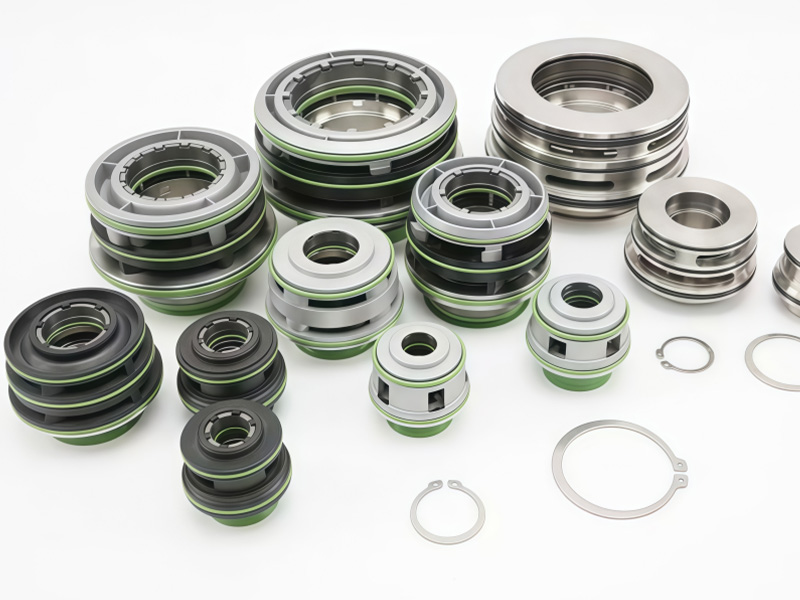
Installation Steps and Precautions for Water Pump Mechanical Seals
The compression amount of the mechanical seal spring must not be excessively large or small; the allowable error is ±2.00 mm. Excessive compression increases the end face specific pressure and accelerates wear on the sealing faces, while insufficient compression results in inadequate pressure and failure to achieve sealing. After installation, the spring should move freely in the spring seat. Pay attention to the spring rotation direction—it must be opposite to the pump shaft rotation direction.
After installing the moving ring (rotary ring), ensure it can move flexibly. When the moving ring is pressed toward the spring, it should automatically spring back.
First, fit the static ring O-ring onto the back of the static ring, then install it into the seal gland. Take care to protect the static ring sealing face, ensuring perpendicularity between the static ring face and the gland centerline. Align the anti-rotation groove on the back of the static ring with the anti-rotation pin, but do not allow them to touch each other.
During the installation of the mechanical seal, never strike the seal components directly with tools. Use special installation tools to avoid damaging the seal parts.
When installing the seal O-rings, apply soap water or other suitable lubricant to prevent damage to the rubber during assembly. Apply a thin layer of grease between the dynamic and static sealing faces to prevent dry friction damage before the pump starts.
When assembling the floating ring assembly, be careful not to touch or damage the floating ring spring, as this may affect floating performance. After assembly, gently press the floating ring to confirm it has good floating capability.
Handle the mechanical seal gently during installation to avoid damage. Clean the seal components and the seal cavity thoroughly before installation.
When tightening the mechanical seal, apply even force to the bolts to prevent uneven loading that could damage the seal. For quick-install type seals, after assembly, remember to move the positioning tab radially away from the shaft and secure it in place.
Since different water pumps transport different media, the media encountered by the mechanical seal vary (e.g., hot water vs. cold water, different temperatures, cavity pressures, and corrosiveness). Therefore, the mechanical seal design and installation process will differ accordingly.
The mechanical seal is one of the most effective sealing methods for water pumps. It requires high machining precision, especially for the dynamic and static rings. Incorrect installation methods or improper use after installation will not only prevent effective sealing but may also cause damage to the mechanical seal components.