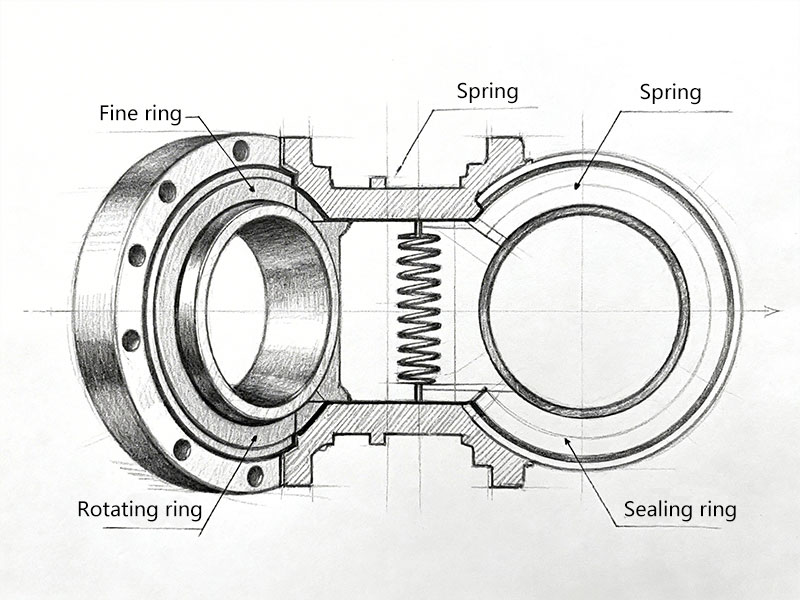
Mechanical Seal Installation and Operation Manual

The structural type and sealing materials of the mechanical seal, along with correct installation and usage, are key to ensuring its long-term stable operation, safety, and reliability. Improper installation or usage can result in poor sealing performance, shortened service life, or complete seal failure. Therefore, please pay attention to the following points during installation and operation of the mechanical seal:

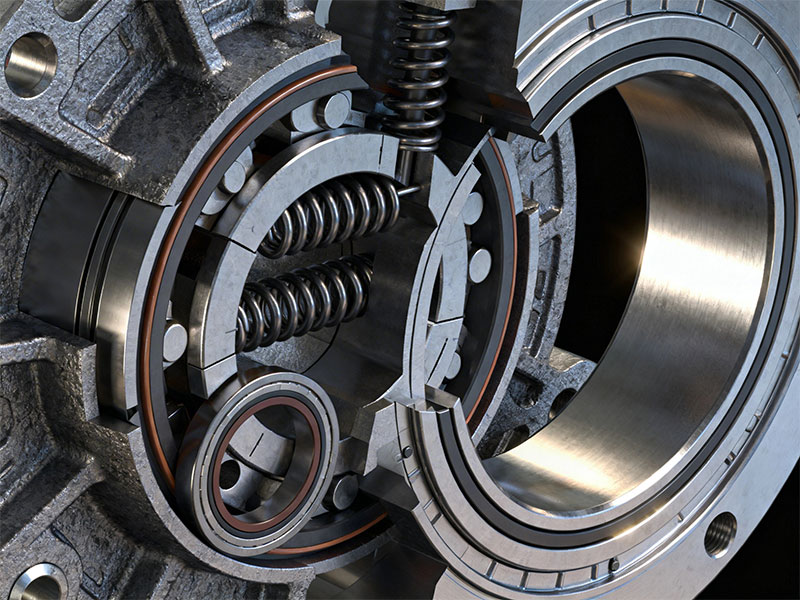
I. Inspection

  1. Check whether the dimensional accuracy, geometric accuracy, and mutual relationships of the host machine’s sealing installation location meet the technical requirements. Confirm that the mechanical seal model matches the pump model being used, and inspect the mechanical seal assembly for any damage, deformation, or other defects.
  2. Shaft radial runout should be ≤ 0.04 mm, axial movement should be ≤ 0.3 mm, and shaft end runout should be ≤ 0.1 mm. All shaft end portions where non-metallic elements (such as O-rings) are installed should have a 2 × 30° chamfer with smooth transition.
  3. Ensure that the end face runout of the stationary ring relative to the shaft is ≤ 0.04 mm.
  4. For locations where the seal ring slides, the surface roughness Ra value should not exceed 1.6 μm.

II. Installation

  1. Before installation, thoroughly clean the seal chamber of the host machine. Keep the installation process clean. Apply a thin layer of clean lubricant (for EPDM rubber, do not use oil; use detergent or soapy water instead) to the dynamic ring, static ring surfaces, auxiliary seals, and other contact areas to facilitate smooth installation of the mechanical seal.
  2. Slide the mechanical seal (including the inner sleeve) onto the shaft, and slowly push/rotate it toward the motor end. Pay attention to the direction of the inlet and outlet ports to make connection of the inlet/outlet valves easier.
  3. Bolt the complete mechanical seal assembly together with the stuffing box (seal chamber) and securely fasten it to the stuffing box.
  4. Install the rear cover plate (back vane/impeller guard), tighten the pump impeller and other pump components, adjust the impeller position to the normal operating state, and check whether the clearance between the rear cover plate and the impeller is uniform (typically around 3 mm).
  5. Evenly tighten the socket head cap set screws (grub screws) on the mechanical seal drive collar. After confirming correct installation, before starting the pump, remove the limit block and socket head cap screws. (Note: Keep the removed positioning block and socket head cap screws safely for future disassembly of the mechanical seal.)
  6. Manually rotate the shaft to check whether it turns freely. If yes, proceed; if not, identify and correct the cause before continuing.
  7. Connect the flushing water valve. The flushing fluid can be ordinary tap water or a liquid compatible with the process medium. Control the pressure at approximately 0.1–0.3 MPa to ensure normal circulation. Its purpose is to flush, cool, and lubricate the mechanical seal (see attached diagram for cooling/flushing liquid inlet and outlet).
  8. Perform a trial run of the pump. Before running the pump, open the flushing water valve 10 minutes in advance. Strictly prohibit dry running of the pump.

Remark: The mechanical seal is a wearing part. During installation, do not strike or force it into place, otherwise the seal is easily damaged, leading to leakage.

III. Operation

  1. Open the pump inlet valve to introduce the medium. Under a certain static pressure, observe the sealing condition. The pump chamber must always remain filled with liquid. Avoid dry running and cavitation as much as possible.
  2. Slowly rotate the shaft and observe whether there is any leakage. If significant leakage occurs, there may be issues with the seal or other components. Disassemble the seal, carefully inspect for the cause, correct it, and reinstall.
  3. During the initial pump start-up, slight seepage may occur, but if the leakage gradually decreases, this is normal. If leakage gradually increases, it indicates an installation error or seal problem. Stop operation immediately, disassemble the pump, identify the cause, and reassemble the seal.
  4. During seal operation, pay attention to the following conditions to ensure maximum service life:
  • Avoid medium pressure fluctuations
  • Avoid frequent start/stop cycles
  • Avoid pump dry running and cavitation
  • Prevent interruption of cooling/flushing water → Before pump operation: open the flushing valve 10 minutes in advance to allow flushing liquid to flow → After pump shutdown: continue flushing for 10 minutes before closing the flushing valve
  • Regularly check whether the seal auxiliary system is functioning normally
  • Avoid using hard water or sudden cold water